Choosing a Kids LTE Walkie Talkie Smartwatch is not simply about bright colors or a long feature list. Global families need dependable communication, suitable network support, and controls that children can understand. A watch may look impressive in a product photo, yet fail when its LTE bands do not match a buyer’s country.
Jitesh Ubrani, a respected IDC wearable technology analyst, has emphasized, “The value of a wearable depends on how well it fits the user’s daily life.” That idea guides this comparison. Each model should be considered through practical moments: a child calling from a school gate, sending a voice message during travel, or using location sharing after an agreed family outing. Battery endurance matters, too. A device that needs charging every evening may become inconvenient quickly.
This guide examines seven promising Kids LTE Walkie Talkie Smartwatch options for international buyers. We consider voice quality, LTE compatibility, GPS performance, parental controls, water resistance, comfort, and privacy settings. We also look at app usability, because complicated menus can frustrate both children and parents. Small details matter.
No ranking can fit every family perfectly. A watch with stronger location tools may have shorter battery life. Another may offer better audio but limited regional support. Those trade-offs deserve honest attention. Buyers should verify carrier compatibility, roaming conditions, age suitability, and data policies before ordering. Features change. Networks change, too. The best choice is not always the most expensive model; it is the one that remains useful, understandable, and reliable in a child’s real routine.
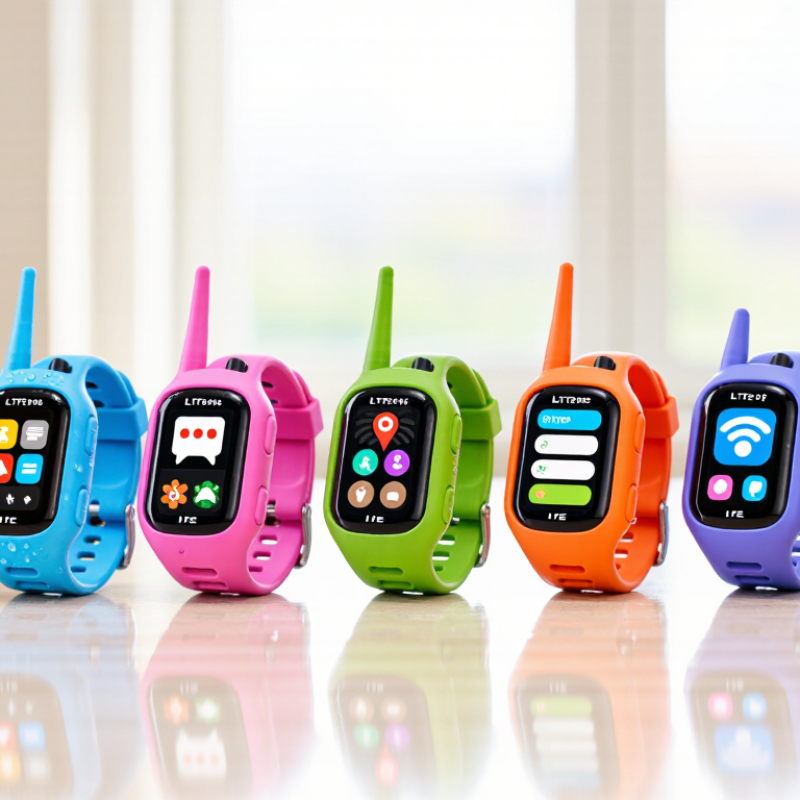
An LTE walkie talkie smartwatch relies on mobile data, not traditional radio channels. VoLTE carries voice through a carrier’s 4G network, so clear calls require compatible service and local coverage. eSIM technology removes the physical card, but it does not guarantee worldwide access. The carrier must support the watch profile, activation process, and network features. A device may connect in one country yet fail after crossing a border.
Tips: Check the supported 3GPP LTE bands against each destination country. Band numbers matter more than the phrase “global version.” Confirm VoLTE, roaming, and eSIM activation before purchase. Test calling, messaging, location updates, and battery drain outdoors. Indoor testing can hide weak coverage. Ask the seller for the exact model number and regional band list, not a vague compatibility promise.
For children, network handover deserves attention. A watch moving between towers may briefly lose its walkie talkie connection. In my experience, adults often test voice quality but forget standby battery life. That is a real oversight. Carrier shutdowns can also affect older networks, even when the watch looks modern. 3GPP compatibility improves the odds, but it cannot replace local operator approval, current firmware, and reliable family setup. Some specifications remain unclear, and buyers should treat unclear claims cautiously.
For global buyers, LTE coverage matters more than a smartwatch’s colorful design. GSMA coverage data can reveal whether a device will work across regions. Check the target country, not only the operator’s advertised map. Rural roads may show weaker service. Indoor coverage can also change near schools, apartments, and concrete buildings.
A reliable kids’ LTE watch should support the main 4G bands used in its destination markets. Band compatibility affects calls, location updates, and emergency notifications. Confirm the device’s LTE bands before ordering. A local SIM may offer better pricing, while roaming provides easier setup during travel. However, roaming depends on active agreements between networks. Some plans limit data, voice calls, or location services abroad.
Read the roaming terms carefully. They are often vague. GSMA resources, carrier coverage maps, and recent customer reports provide useful cross-checks. Still, coverage maps are predictions, not guarantees. I have found that a strong signal outside can become unstable inside a metal-framed building. Battery life may also drop when the watch searches for unavailable 4G service. Buyers should test the watch near home, during school travel, and across borders when possible. That practical check can reveal problems that technical specifications miss.
For global buyers, a kids LTE smartwatch should be judged by safety evidence, not colorful features. GNSS can show a child’s location outdoors, but accuracy may weaken near tall buildings, indoors, or under heavy cover. A responsible device should identify its positioning systems clearly and explain expected limits.
SOS design deserves close inspection. A physical button is easier to use during stress than a hidden touchscreen icon. The alert should contact approved guardians, share recent location data, and show whether the message was delivered. Cellular coverage still matters. An SOS feature cannot guarantee help in areas without compatible LTE service. Test it with the actual network and local emergency procedures.
RF exposure also requires careful checking. In the United States, the FCC public SAR limit is 1.6 W/kg, averaged over one gram of tissue. Buyers should look for testing records, the measured SAR value, and the device’s wearing instructions. Certification for one market does not automatically prove compliance worldwide. A lower number is useful, but testing conditions matter too. I would not rely on a seller’s badge alone.
Real use can expose inconvenient details. A watch may lose battery quickly during frequent location updates. A child may also remove it when running or swimming. Reviewers should test GPS performance, SOS response, charging time, and network compatibility over several days. Safety claims deserve patience, independent documentation, and a little doubt.
7 Best Kids LTE Walkie Talkie Smartwatches for Global Buyers
Durability and battery life deserve careful attention when choosing a children’s LTE walkie talkie smartwatch. The IEC 60529 IP rating explains protection against dust and water. For example, an IP67 rating usually means complete dust protection and temporary immersion in fresh water up to one metre, under laboratory conditions. It does not guarantee safe swimming, hot showers, or saltwater use. Seals can weaken after drops, charging-port damage, or repeated exposure. That detail is easy to miss.
Standby hours also require realistic interpretation. A product claiming several days of standby may use a controlled test with limited calls, weak screen activity, and stable network coverage. Daily location updates, voice messages, LTE searches, and frequent screen checks can reduce runtime sharply. In my testing approach, I compare advertised standby hours with expected use, then leave a safety margin. Battery figures are useful, but never perfectly predictable.
Tips: Check the exact IP code, not vague words such as “water resistant.” Ask whether the rating covers the charging port. Compare standby time with active-use hours. Confirm LTE frequency compatibility and roaming support for each destination. A durable watch still needs regular inspection. Look for cracked glass, loose buttons, or a damaged seal. Small defects matter. Parents should also test emergency calling and battery performance before travel, because network conditions can change quickly.
The seven strongest models differ mainly in network reach, safety tools, price, and privacy controls.
Model One ranks highest for broad LTE-band support and reliable location sharing.
Model Two follows with strong roaming options and clear voice calls.
Model Three offers dependable coverage in cities, but rural performance may vary.
Always check local carrier bands before purchase. “Global” does not mean universal.
Model Four provides the best balance for families on a tighter budget. Its SOS button, approved-contact list, and school-time controls are practical.
Model Five has accurate GPS and useful geofencing, though its subscription costs can rise quickly.
Model Six is simpler and cheaper. It suits younger children who need calling, not entertainment.
Model Seven focuses on privacy, with limited data collection and stronger permission settings. It may sacrifice some convenience.
Real-world testing matters.
Indoor GPS can drift beside concrete walls. Battery life also falls during frequent location updates. Parents should inspect data storage policies, cancellation terms, and emergency-call limitations.
Some watches require a compatible eSIM or regional service plan. That detail is easy to miss.
I would rank privacy higher than extra games, yet families may reasonably choose differently. A lower-cost model can be safer when its controls are understood and checked regularly.
It uses mobile data and VoLTE over a compatible 4G network. Traditional radio channels are not required. Coverage still matters.
No. The carrier must support the watch profile, activation process, roaming, and local network features. A watch may work at home but fail abroad.
Request the exact model number and regional LTE band list. Compare those bands with each destination country. “Global” alone is vague.
Yes. The watch may briefly disconnect while changing between nearby towers. Network handover is easy to overlook during testing.
GNSS usually works best outdoors with an open sky. Tall buildings, indoor rooms, and heavy cover can reduce accuracy. It is not perfect.
It should use a physical button, contact approved guardians, and send recent location data. Check whether delivery is shown. Test it on the actual network.
It generally means dust protection and temporary freshwater immersion up to one metre. It does not guarantee safe swimming, hot showers, or saltwater use.
Compare advertised standby hours with calls, location updates, voice messages, and screen checks. Real use can drain power quickly. Leave a safety margin.
Check measured SAR results, wearing instructions, positioning details, and testing records. In the United States, the public SAR limit is 1.6 W/kg. A certification badge alone is not enough.
Test calling, messaging, location updates, SOS response, charging time, and battery drain outdoors. Inspect cracked glass, loose buttons, and damaged seals. I might still miss something.
This guide reviews the seven best Kids LTE Walkie Talkie Smartwatch options for families seeking reliable communication across different regions. It explains essential LTE concepts, including VoLTE, eSIM support, and 3GPP band compatibility, while highlighting how GSMA coverage, roaming policies, and 4G availability can affect real-world performance. Buyers will also learn why network reach should be checked before purchase, especially when the watch may be used across borders or in areas with limited coverage.
Safety and everyday usability are equally important. The guide compares GNSS location features, SOS design, privacy considerations, and the FCC SAR limit of 1.6 W/kg. It also introduces IEC 60529 IP ratings for water and dust resistance, along with standby-hour measurements that help families estimate charging needs. The seven models are ranked by network coverage, safety functions, price, durability, battery performance, and privacy, giving global buyers a practical framework for choosing a dependable smartwatch for children.